Pursuing the Next Gateway Rather Than Protecting Existing Businesses: Why CEO Takeshi Idezawa Is Betting on Agent i



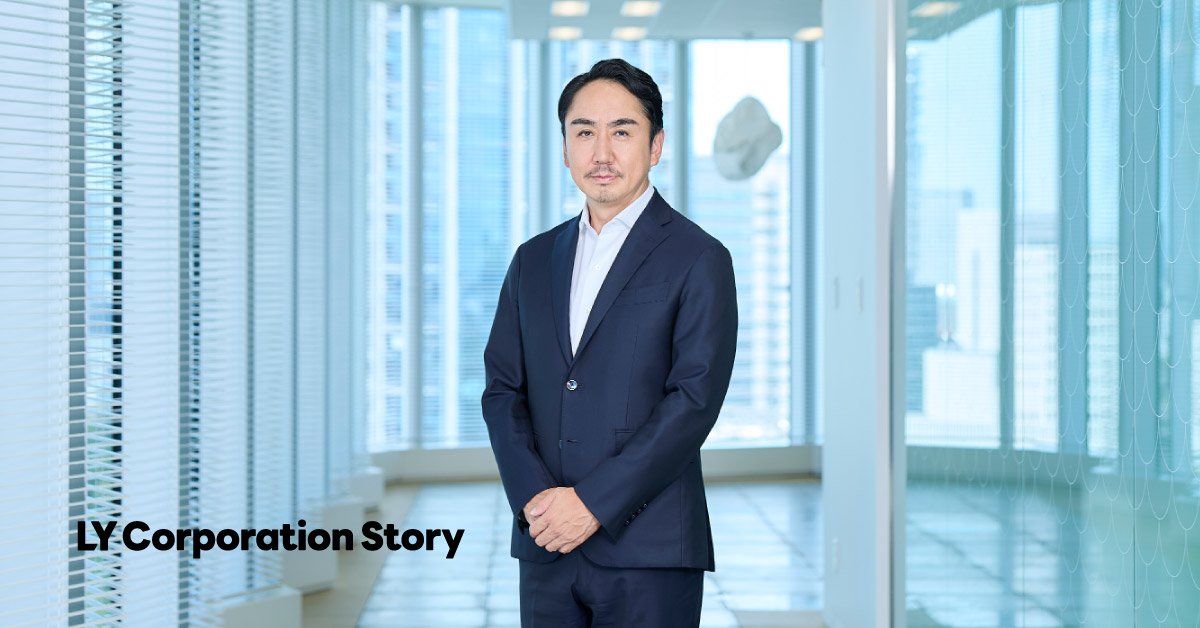
Now is not the time to focus on protecting and maintaining the status quo.
Rapid advances in generative AI are poised to fundamentally change how people use internet services. Search and other services that LY Corporation has provided to date are no exception.
Amid these changes, LY Corporation has adopted "Disrupt and Reinvent" as one of its values. Rather than holding on to existing assumptions, the Company is reassessing them and setting out to create a new "gateway" that meets users' needs. At the heart of this effort is "Agent i," the Company's AI agent. Alongside its existing development organization, small teams of employees recruited internally have begun developing products in new ways that transcend conventional divisions of labor.
We spoke with CEO Takeshi Idezawa about how he sees the changes brought about by AI, why he believes LY Corporation needs to drive change itself, what the Company is betting on, and what capabilities will remain uniquely human in an era when AI takes on more of our work.

- Takeshi Idezawa
- President and Representative Director, CEO (Chief Executive Officer), LY Corporation
After graduating from Waseda University, Idezawa joined a life insurance company and worked in sales. In 2002, he moved to Livin' on the Edge Co., Ltd. In April 2007, he was appointed CEO of livedoor Co., Ltd., where he spearheaded the company's turnaround. Following a buyout and management integration, he became a Director of NHN Japan Corporation in January 2012. He later served as Director of LINE Corporation (formerly NHN Japan) starting January 2014, Representative Director, President and CEO from April 2015, and Representative Director, Co-CEO of Z Holdings Corporation from March 2021. He assumed the current position in October 2023.
FY2025: The First Year of the Shift to AI Agents
―Generative AI evolved rapidly in FY2025. How do you view the past year?
For LY Corporation, FY2025 was the first year of the shift to AI agents. At the beginning of the year, we established an internal policy of providing AI agents for general users. In about one year, we announced and launched Agent i on April 20, 2026.
During that time, the capabilities of large language models (LLMs) improved rapidly. Code generation also advanced, enabling the development of services with far fewer people and much less effort than before. But changes in the world are not aligned with our fiscal-year calendar. When circumstances are changing every day, being a large company is not necessarily an advantage. Rather, speed itself is now a competitive advantage.
Simply introducing AI tools to make individual tasks faster is not enough. We need to rethink our work processes themselves and change how and where we store data so that AI can use it effectively. While using AI to build products, we also need to transform ourselves into a company designed around AI. FY2025 was a year in which we worked on both fronts.
―You have experienced major shifts in the business environment before. How does AI differ from previous turning points?
AI is one of the biggest paradigm shifts I have experienced. Unlike previous technological innovations, it affects not only service development but virtually every kind of work, including human resources, general affairs, and finance. And the impact goes beyond work to affect our everyday lives. Whether we like it or not, we cannot ignore it.
Past experience has taught me that when change of this magnitude arrives, turning the wheel halfway is not enough. At the same time, as an organization grows larger, so does its inertia. Even if management makes a sharp turn, the entire organization cannot immediately follow. How can we redirect a large organization? I believe this is a defining moment for both LY Corporation and myself personally―one that will test the experience we have accumulated to date.

Pursuing the Next Gateway Rather Than Protecting the Search Business
―Some believe that generative AI will disrupt existing businesses, including our search business. How do you view this transformation?
Internet services, including search, are likely to undergo significant change. Search is one of the services closest to what users seek to accomplish because the words users enter express intentions such as wanting to know something, make a purchase, or go somewhere. This proximity to user intent is what made search a highly profitable business.
But no matter how profitable it is or how much we want to protect it, we cannot stop users' needs from changing. In the AI era, the interface closest to users' interests and intended actions is likely to shift toward AI. We will not be able to respond quickly enough if all we do is experiment with AI on a small scale while trying to prevent existing revenue from declining.
That is why we are going after the next "interface" with Agent i. This is not an initiative to protect our existing businesses; it is a challenge to become the gateway for the next generation. The future is by no means certain. But doing nothing is not an option. We believe the future lies here, and this is where we are placing our bet.
―Global AI companies possess financial resources on an entirely different scale. How can LY Corporation compete with them?
LY Corporation has touchpoints with users across many aspects of everyday life, including media, commerce, and financial services. This means more than simply having multiple revenue sources. Our strength lies in our ability to connect services and enable users to accomplish their objectives within a single experience without requiring complex operations.
For example, users may want an agent to purchase a product when its price falls, remind them about the weekend weather, or bid in an auction up to a specified amount. We can enable users to fulfill these everyday needs without requiring advanced knowledge of AI. Making sophisticated AI designed for professionals accessible to ordinary users in their daily lives is an area in which I believe LY Corporation is uniquely positioned to take on the challenge.
We have a massive user base, strong development teams, and services that act as gateways to users' everyday lives and support them through actions such as reservations and purchases. By combining these strengths, we can become the gateway users turn to first when they want to do something. If we can do that, I believe revenue will follow.
―If Agent i prioritizes LY Corporation's own services, there is a possibility that it will not always make the best recommendations for users. What do you think about this?
I don't think we need to prioritize protecting our own ecosystem. If users want to connect to external services, that's fine. Our priority is to make Agent i a truly great service.
At the same time, if AI makes it easier to compare products and services, experiences such as deciding where to make purchases or reservations may become increasingly similar. If that happens, users may actually place more value on having a familiar gateway they already use every day, along with the convenience of having connected services such as points and payments. That could give users more reason to choose us.
Rather than locking users into our own services, we should let them connect to whichever service works best for them, whether it is ours or one offered by another company. Ultimately, what matters is creating an experience that leads users to conclude that "continuing to use LY Corporation's services is more convenient."

Beginning With Those Ready to Act Rather Than Waiting for Everyone to Change
―You updated LY Corporation's mission and values for the AI era. How do you think organizations need to change?
I do not think organizational transformation should be measured by whether everyone has come to share the same mindset. If we wait for everyone to change at the same time, we will not be able to keep pace with this era. The important thing is for those ready to act to move first and create new examples of success.
Companies with large and highly profitable existing businesses are particularly prone to the concern that pursuing something new could undermine their current businesses or revenue. Even when people genuinely have the company's interests at heart, established rules and workflows can hold them back from taking the next step. That is the classic innovator's dilemma.
AI changes not only services but also how each individual works. We need to question every assumption we have taken for granted, asking, "Why does this process exist?" and "Is this division of labor really necessary?" If we spend our time looking for reasons not to act, change will leave us behind.
―In developing Agent i, you adopted a new structure involving small teams recruited internally and operating separately from the regular organization. How has that worked so far?
In preparation for the Agent i announcement, we formed small teams by bringing together employees who had volunteered with similar ideas about the services they wanted to build. The members made extensive use of AI, and I feel this approach has helped accelerate development. We are now moving forward with the second and third initiatives under this approach.
Traditionally, service development has been divided among roles such as planning, design, and engineering, with each stage of the process connected to the next. When small teams develop products with AI built into the process from the start, however, the boundaries between those roles become less distinct. The team defines the goal and the problem to solve, uses AI for development, and exchanges feedback while looking at a prototype. Planners, designers, and engineers start thinking about the entire product together.
We are still at an early stage, but a new form of product development suited to the AI era is beginning to take shape. The next priority is to increase these new initiatives and extend this approach to product development throughout the Company.

As AI Refines Work, Human Insight Becomes the Differentiator
―How do you personally use AI in your day-to-day work?
Before meetings, for example, I use AI to analyze our internal wiki, minutes from previous meetings, and other materials, compare them with the documents submitted for the upcoming meeting, and identify issues and points for discussion. We have significantly reduced meetings that are primarily for reporting, allowing us to spend more time on actual discussion.
In addition, when I want a document prepared, a meeting structure changed, or a new initiative launched, I can first use AI myself to get it about 70%-80% done before making the request. That allows me to communicate my intentions more concretely and also speeds up the work of the person receiving the request.
With AI able to do this much, I sometimes wonder whether the role of president is even necessary. (Laughs.)
―That said, what do humans still need to do?
We need to make the final decision and take risks. The information needed to make decisions is not limited to internal documents and data available on the internet. Decisions also involve things that are difficult to turn into data: undocumented history, relationships and emotions between people, individual personalities, and the general mood among users and in society.
With AI, anyone can make a document look polished on the surface. But there is still a difference between a document that communicates something meaningful and one that "looks polished but says nothing." What makes the difference is how deeply you instruct AI and how you give it feedback. This is where a person's experience and perspective become apparent.
As AI becomes more capable, instincts and insights that come from such experience and perspective will become differentiating factors. It will be more important than ever not only to decide what AI should do, but also to decide what you yourself want to accomplish and to demonstrate it by turning your ideas into something tangible.
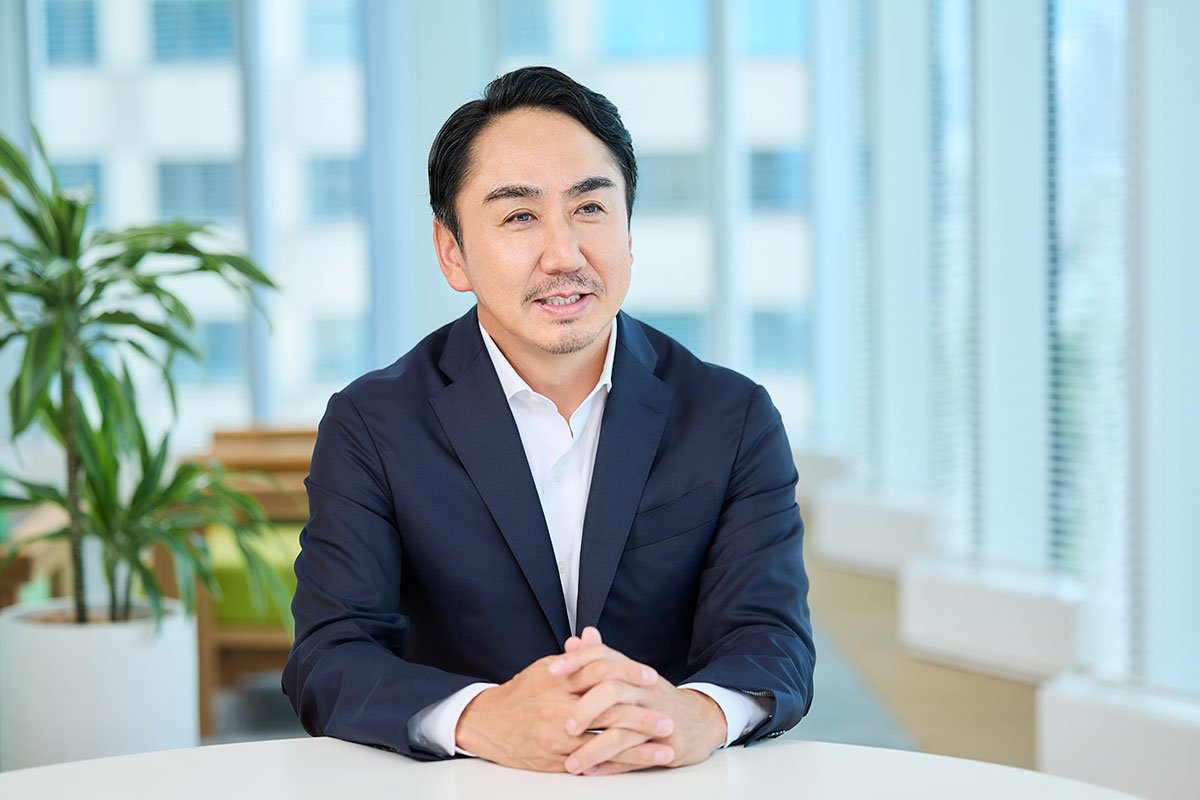
The Race Is On Now―and We Need Results Fast, Not 10 Years From Now
―For example, what would Agent i need to become 10 years from now for you to consider it a success?
I do not consider Agent i on a 10-year timescale. 10 years from now, the name Agent i itself may no longer exist. The pace of change in this field is that rapid.
Our first goal is to reach a point where many people across Japan use Agent i naturally as part of their everyday lives. After LINE launched in 2011, adoption grew explosively almost immediately.
This is not a race we intend to fight over 10 years. What matters is how quickly we can make Agent i a service that people choose in their daily lives.
―What are your goals for the coming year?
FY2025 was the year in which we declared our shift toward AI agents and laid the groundwork. FY2026 is the year when we need to deliver results.
We are neither in a phase of protecting and maintaining what already exists nor one of pursuing stable growth. We are in a phase where we need to move faster, disrupt what we have built ourselves to create something new, and aim to be No. 1. We expressed that determination in our values: "10x Faster," "Disrupt and Reinvent," and "Uncompromising Pursuit of No. 1."
Internet services are structured in a way that gives the No. 1 player an overwhelming advantage. But that does not mean anything goes as long as we win. Our mission, "WOW Our Users!," is about using technology to make the world a better place and delivering positive surprises to users.
Rather than fearing change, we want to enjoy changing ourselves. And we want users to experience the transformation of Agent i and our Company as something that delivers real value. That is what I want to accomplish over the coming year.
Related Links
Interview date: July 27, 2026
Written by: LY Corporation Story Editorial Team Photos by: Naoyuki Inomata
*The affiliations and titles in the article are as of the time of the interview.

- About The LY Corporation Story
- Making daily life more convenient and exciting for everyone.
As our corporate blog, The LY Corporation Story will share the inside story behind the challenges that we take on to create WOW as well as the thoughts and feelings behind them.